Hire a Developer for Custom AI Automation in Florida
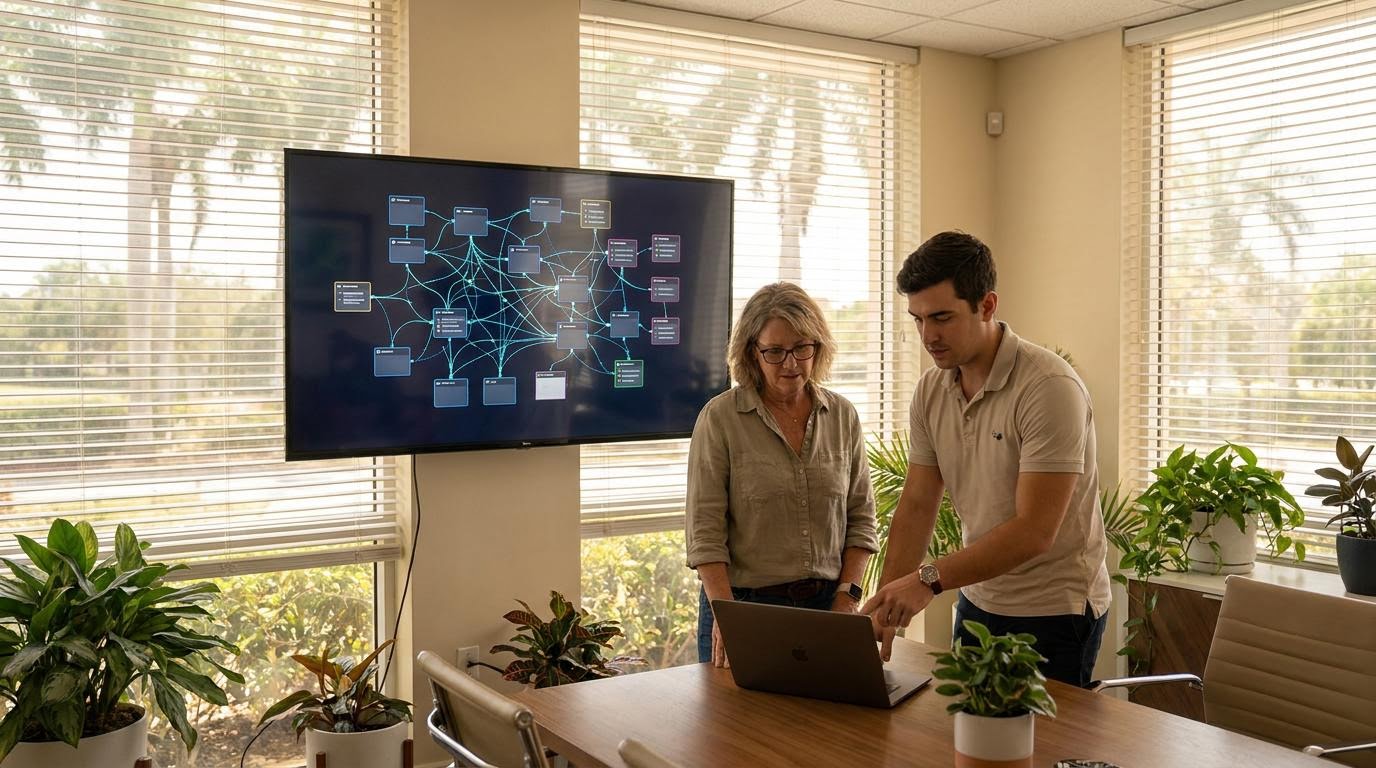
Yes - any Florida business can hire a developer to build custom AI automation and CRM integrations, and nothing in Florida law requires a special license to do that work. The real questions are narrower: what to scope, who to hire, how it connects to the CRM and phone system you already use, and which consent and data-handling rules belong in the spec before a single workflow goes live.
- Software development is not a licensed trade in Florida, so vet a developer on live examples, references and code ownership - not on a state license number.
- Most Florida builds are integrations, not inventions: wiring your CRM, forms, call tracking and ad accounts together so leads route and follow up on their own.
- Write texting consent and customer-data handling into the project spec up front, not after launch.
- Freelancer, dev shop and in-house hire each fit a different stage - the comparison below shows which.
- Ask that offline conversion data flow back into Google Ads, so automation improves ad spend instead of just tidying your inbox.
Yes - and Florida does not license software developers
Florida regulates trades like roofing, electrical and plumbing through the Department of Business and Professional Regulation. Software and AI development is not one of those licensed trades, which means there is no state registry to look a developer up in.
That shifts the burden of verification onto you. Ask for working examples you can click, references you can call, and a written agreement that spells out who owns the code and confirms your company holds admin access to every account, API key and repository involved.
What Florida businesses actually ask to have built
Almost nobody needs a model trained from scratch. What gets requested is plumbing between systems that already hold your money-making data.
- AI intake on calls and forms - capturing job type, city or ZIP, and urgency, then tagging the lead before a human sees it.
- Lead routing by service area - a Pompano Beach request and a Miami request going to different crews or queues automatically.
- Call-and-form deduplication - so the same homeowner who filled a form and then called is one lead, not two.
- Automated quote follow-up - sequenced reminders on unsigned estimates, written in your voice.
- Review requests after job completion - triggered from the CRM job status, not from a manual list.
- Offline conversion imports - booked jobs pushed back into your ad platform so bidding optimizes toward revenue.
- Bilingual intake - English and Spanish handling, which matters a great deal for Miami-area lead flow.
Why the Florida angle changes the build
Florida demand is not flat, and automation that ignores that pattern breaks exactly when it matters. Storm season pushes roofing, restoration, garage door and tree service inquiries into sudden spikes where the first responder usually wins the job.
Winter brings the seasonal resident surge through Broward and Palm Beach counties, with a wave of property checks, repairs and reopenings. And cooling demand never really stops, so HVAC intake needs an after-hours path year round. A good spec plans for the peak week, not the average one.
Freelancer, dev shop or in-house hire?
| Option | Best for | Watch out for |
|---|---|---|
| Freelancer | One narrow automation you can describe in a page | Single point of failure; support gaps when they move on |
| Agency or dev shop | Builds that touch ads, CRM, site and reporting together | Confirm you keep ownership and admin access to everything |
| In-house developer | Daily internal tooling and a long roadmap | Hardest to justify until the workload is continuous |
Two Florida rules to write into the spec
Automation that contacts people is where compliance risk lives. The Florida Telephone Solicitation Act governs automated sales calls and texts to Florida consumers, so your build needs a real consent record - what the person agreed to, when, and from which form - plus honored opt-outs across every sequence.
The Florida Information Protection Act creates duties around securing personal customer information and notifying people if it is breached, on a statutory deadline. Practically, that means deciding early what data the automation stores, where it lives, who can see it, and what gets sent to third-party AI services. This is spec work, not legal advice - loop in your own counsel for the wording.
What to hand your developer on day one
- A list of the systems involved - CRM, phone or call tracking, forms, scheduling, ad accounts.
- Admin logins or owner-level invites, not a shared staff password.
- The current manual process, written as steps, including who does what today.
- Your definition of a qualified lead and what counts as a won job.
- The one metric the build is supposed to move.
Working with Cyticx across Florida
Cyticx handles AI programming services and custom integration work for businesses across Florida, including Fort Lauderdale, Miami, Boca Raton, Coral Springs, Pompano Beach and Coconut Creek. Because the same team runs Google Ads management, automation gets built to feed the ad account rather than sit beside it.
That also covers the storefront side - ecommerce website development when orders, inventory or customer records need to sync with the rest of the stack. If you are hiring locally in Broward County, start at our Google Ads agency Fort Lauderdale page.
Ready to scope it? Book a strategy call, bring the list of systems above, and we will map what to automate first, what to leave alone, and what it takes to build it.
Frequently Asked Questions
No. Florida licenses trades like roofing, electrical and plumbing through the Department of Business and Professional Regulation, but software and AI development is not a licensed trade. Because there is no state registry to check, vet developers on working examples, client references, and a written agreement covering code ownership and admin access.
In most cases, yes. If your CRM exposes an API or supports webhooks, a developer can connect intake, lead routing, follow-up and reporting to it. Older or fully custom databases can still be integrated, though the approach depends on how the data is stored and whether a direct or middleware connection is safer.
Both are scoped after a discovery call, because the work depends on how many systems are involved, whether their APIs are documented, and how much of your current process is written down. Cyticx does not publish fixed pricing for custom builds - a defined scope comes out of that first conversation.
Only with proper consent. The Florida Telephone Solicitation Act governs automated sales calls and texts to Florida consumers, so the build should capture and store a consent record tied to the form or source, and honor opt-outs across every sequence. Confirm the specifics with your own legal counsel.
It should. A common part of these builds is pushing booked jobs or qualified leads from the CRM back into the ad account as offline conversions, so bidding optimizes toward real revenue instead of raw form fills.
Have a question about this? Call (954) 621-2381 or get in touch.